The AI Boom and Its Risks · Part 4
Nervous Lenders Are Safe Lenders
This is the fourth in what I expect will be a series of five posts on the role of AI investment in today’s economy. The first post used the Federal Reserve’s macroeconomic model, FRB/US, to estimate the impact of the AI buildout and the associated rise in stock prices on economic growth. The second went through some reasons why stock prices are not obviously detached from reality and why, if the market does fall, a fall on the scale of the dot-com crash is unlikely. The third examined the wealth effect from a falling stock market and found that it would likely not be huge: households did not increase their spending by that much as the market went up, so they would not need to cut back dramatically as it goes down. This post focuses on the financial system, and the final one will be about the economy’s shock absorbers.
Everyone is nervous about the financial system right now. Circular financing. Unregulated private credit. Off-balance-sheet entities. Banks lending to the lenders. It all has the whiff of the frenzy that culminated in the global financial crisis in 2008.
I am also nervous. If there is a big problem lurking in the AI boom, this is where I would expect it to materialize. And it is the type of unknown unknown that does not lend itself to the type of modeling I used to estimate the impact of a possible investment slowdown or of the consumer wealth effect if stock prices fall.
To me, the most reassuring feature about the current moment is precisely that everyone is so nervous. The time to be really worried about the financial system is when everyone is building their plans around something they think is completely safe, and then it turns out not to be—whether that is what they thought was a liquid AAA bond, a money market fund or even the deposit they had in a bank. In 2006 many people worried that house prices were too high. But investors, credit rating agencies and regulators were not particularly worried about the AAA-rated securities built out of those mortgages and used as collateral for overnight loans. Absent those securities the bursting of the house price bubble would have led to a nasty reduction in housing investment but not a financial crisis. The AI buildout is more like the homebuilding than the securities: it is being financed by a combination of equity, cash flow and relatively unleveraged long-term bets in which the duration of the assets is not much longer than the duration of the liabilities.
My argument is not that AI will work out financially in the short run. It might not, and if it does not, then investors will lose a lot of money. My argument is that the risk of those losses being propagated and amplified in anything like the way they were in the financial crisis is relatively low, although of course not zero.
I write all of this at some peril, because it is always easier to talk about worries than to be reassuring. Moreover, although the risks are relatively small, they are growing, as financing for the buildout has moved from cash flow to debt and the expected scale of the buildout keeps growing. In 2024 the five biggest AI spenders’ capital spending used up about half of the cash their businesses generated; over the last four quarters it used up 95 percent. And new borrowing went from paying for about 9 percent of their capital spending in 2024 to about a third in the year through mid-2026, according to FactSet. So I will keep monitoring the situation, and the first stop for my monitoring will be the new and overly comprehensive (sorry!) Econvitals Risk Monitor. In addition, I am about to launch a more digestible monthly email version—you can subscribe here.
This is not 2007
The financial system is in much better shape than it was in 2007. In part that is because of better financial regulation, particularly of banks. In part it is because the memory of that crisis has changed behavior. And in part it is because much of the AI buildout is based on genuine revenue increases—not just speculation about future growth—and has been financed mostly by cash flow and stock rather than by highly leveraged borrowing.
You can see some of the comparisons in Table 1, which shows conditions in roughly mid-2007 (as the first stirrings of the financial crisis were being felt), at the low points of the crisis and today. Not everything is better and safer today; for example, business debt and stock valuations are higher than in 2007. But arguably the most important and systemic variables are far better, including bank capital, household balance sheets and the leverage of the firms holding the risky assets.
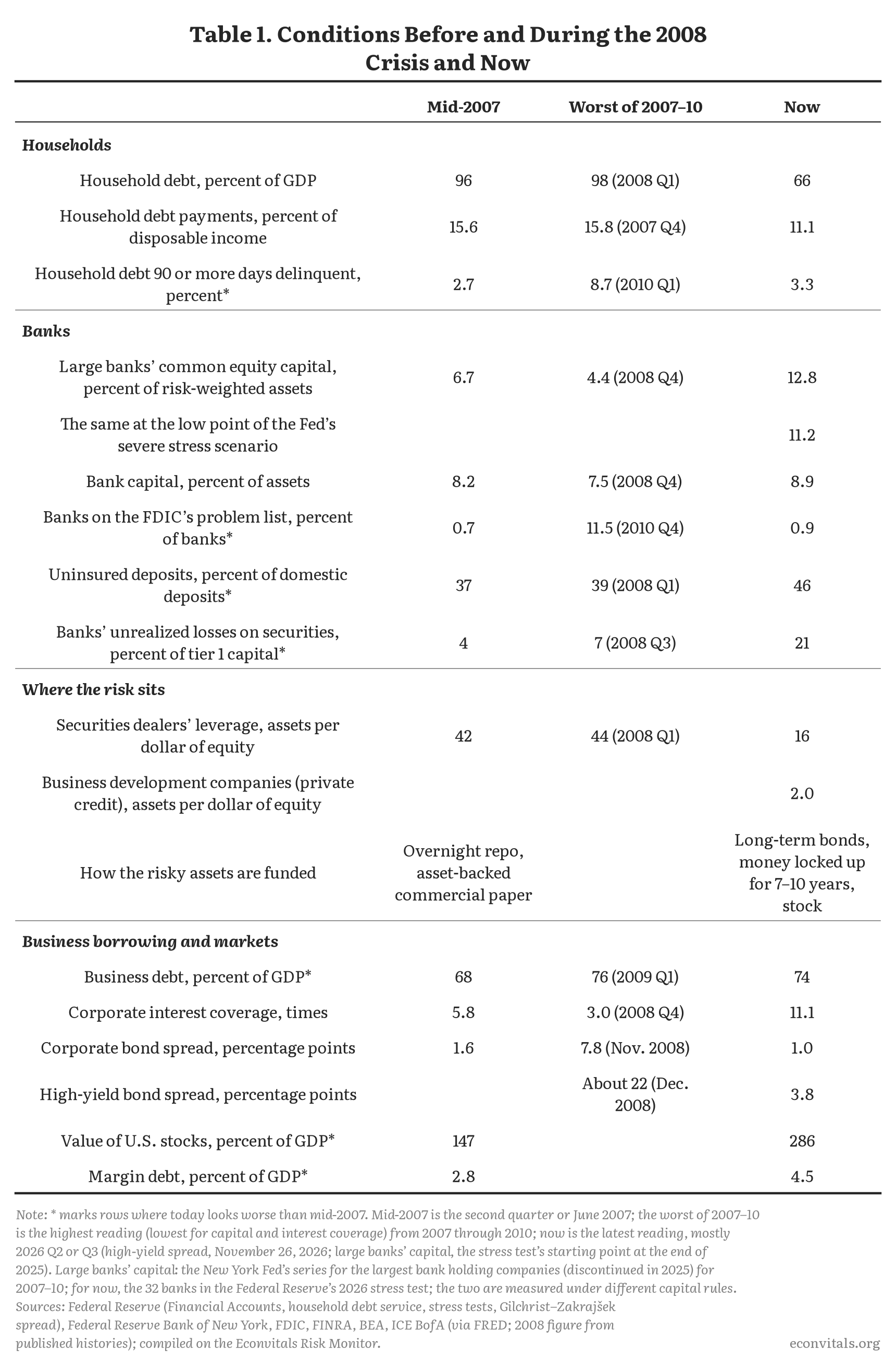
It is not just banks that are in better shape; households are too. Household debt has fallen from about 98 percent of GDP at its 2008 peak to 66 percent, and the share of income going to debt payments from 16 percent to 11 percent. While measures of consumer stress like delinquencies have been rising, they have risen from abnormally low levels in the wake of all the COVID payments to about normal.
The borrowing today is very different from what it was twenty years ago. In the run-up to the financial crisis it was not just that households were overborrowing; it was that their borrowing was turned into what were believed to be completely safe AAA securities that served as collateral for overnight loans. The firms holding the risky assets were levered 30 to 40 times or more, with severe maturity mismatches as long-term loans were financed by overnight borrowing. This time around the leverage in the vehicles holding the risky assets is much lower. The business development companies like Ares Capital and Blackstone Private Credit Fund that make much of private credit’s loans have about one dollar of debt for every dollar of equity and the maturities are more closely matched.
Investors are aware of today’s risk
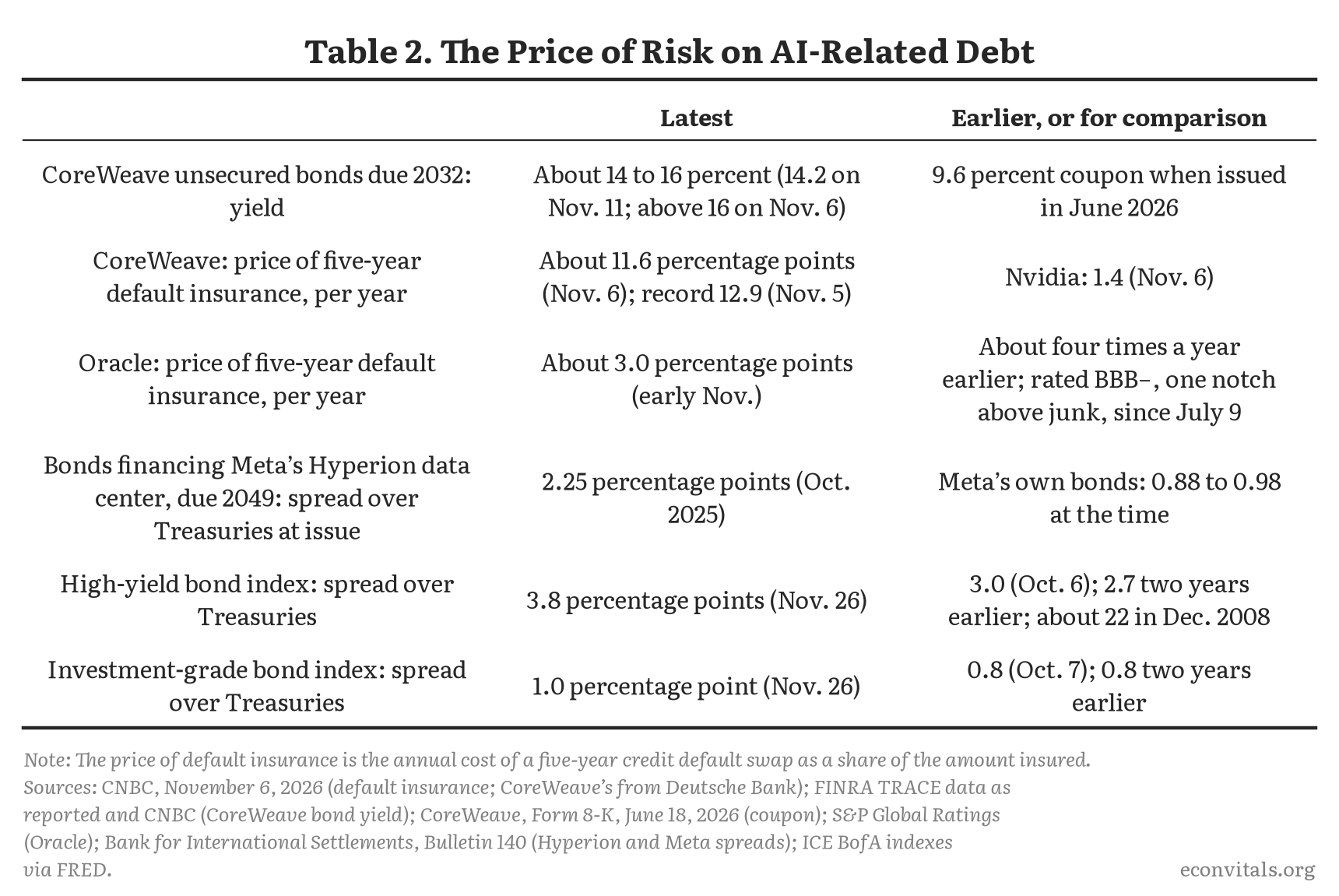
Complacency is at the heart of every financial crisis. Risky assets are treated as if they are safe, and then a dramatic repricing of that risk ripples through the system. Today investors in the weakest parts of the AI buildout are charging very high interest rates, insisting on a high return in exchange for the risk of default (Table 2). That makes these loans somewhat more like equity investments than the mortgage-backed securities at the heart of the global financial crisis. For example, the neocloud CoreWeave, which borrows to buy Nvidia chips that it then rents out, has unsecured bonds that were issued with a 9.6 percent coupon rate and currently trade at about a 15 percent yield. Insurance against CoreWeave default costs about 12 percent a year. Insurance against a default by Oracle, which is borrowing heavily to build data centers for OpenAI, costs about 3 percent a year, roughly four times what it cost a year ago. Even the joint venture that financed Meta’s Hyperion data center had to pay 2¼ percentage points over Treasuries on its bonds, compared with less than 1 percentage point on Meta’s own bonds. As the Bank of England put it last week, “after a prolonged period of unusually compressed credit spreads, an orderly widening that better reflects underlying credit risk can support financial stability.”
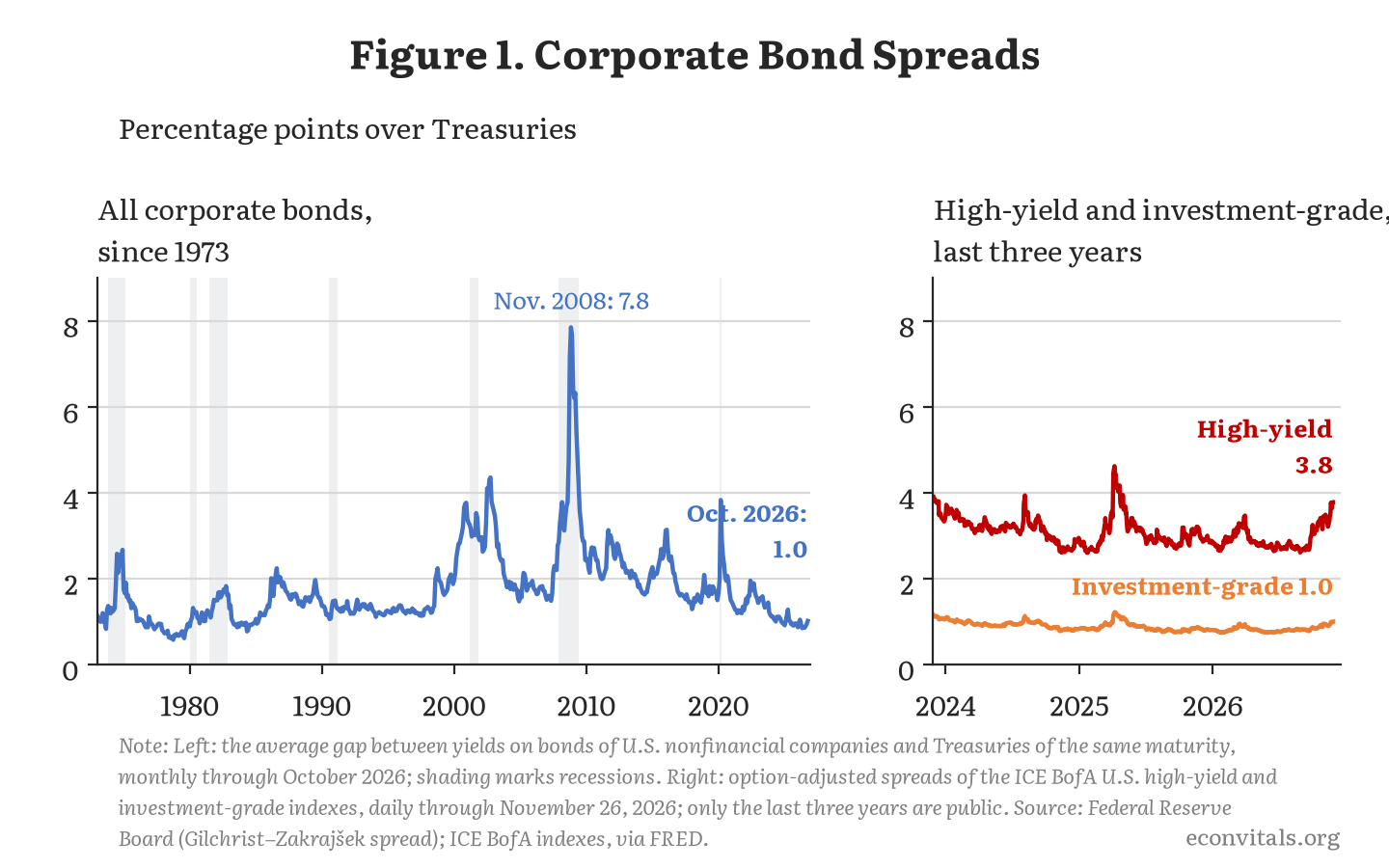
The broader corporate credit market is not pricing in much risk. The extra yield on corporate bonds as a whole is about 1 percentage point, below the roughly 1¾ points it averaged in the years before the financial crisis and at the 15th percentile of its values since 1973 (Figure 1). It is lower than it was three years ago, before the AI buildout had begun on its current massive scale. The spreads on high-yield bonds are up sharply over the last two months, from 3.0 to 3.8 percentage points, but are about where they were three years ago.
I realize that to some degree I am having it both ways, treating high-priced risk as reassuring because the market is self-aware, while treating low-priced risk as a reliable signal that risk is low. I would rationalize it by distinguishing between the potential bubble AI sector where the risk is priced and the rest of the economy, which is not an area of bubble concern and where the pricing is more reliable and reassuring.
It is hard for private credit to run
The financial economist Gary Gorton once wrote, “Financial crises are bank runs, though the form of the ‘banks’ and the ‘bank money’ changes.” Bank runs come in different forms, and the worry today is not a traditional run on deposits like the ones that brought down Silicon Valley Bank and Signature Bank in March 2023.
Many are worried that today the “banks” are private credit firms like Apollo, Blackstone and Blue Owl and “bank money” is the loans they make financed by a combination of institutional investors like pension funds and endowments, wealthy individuals and, increasingly, insurance companies, some of them owned by the lenders themselves. The lending that has many concerned is not just for the AI buildout but also the software industry, which is at great risk because of that buildout.
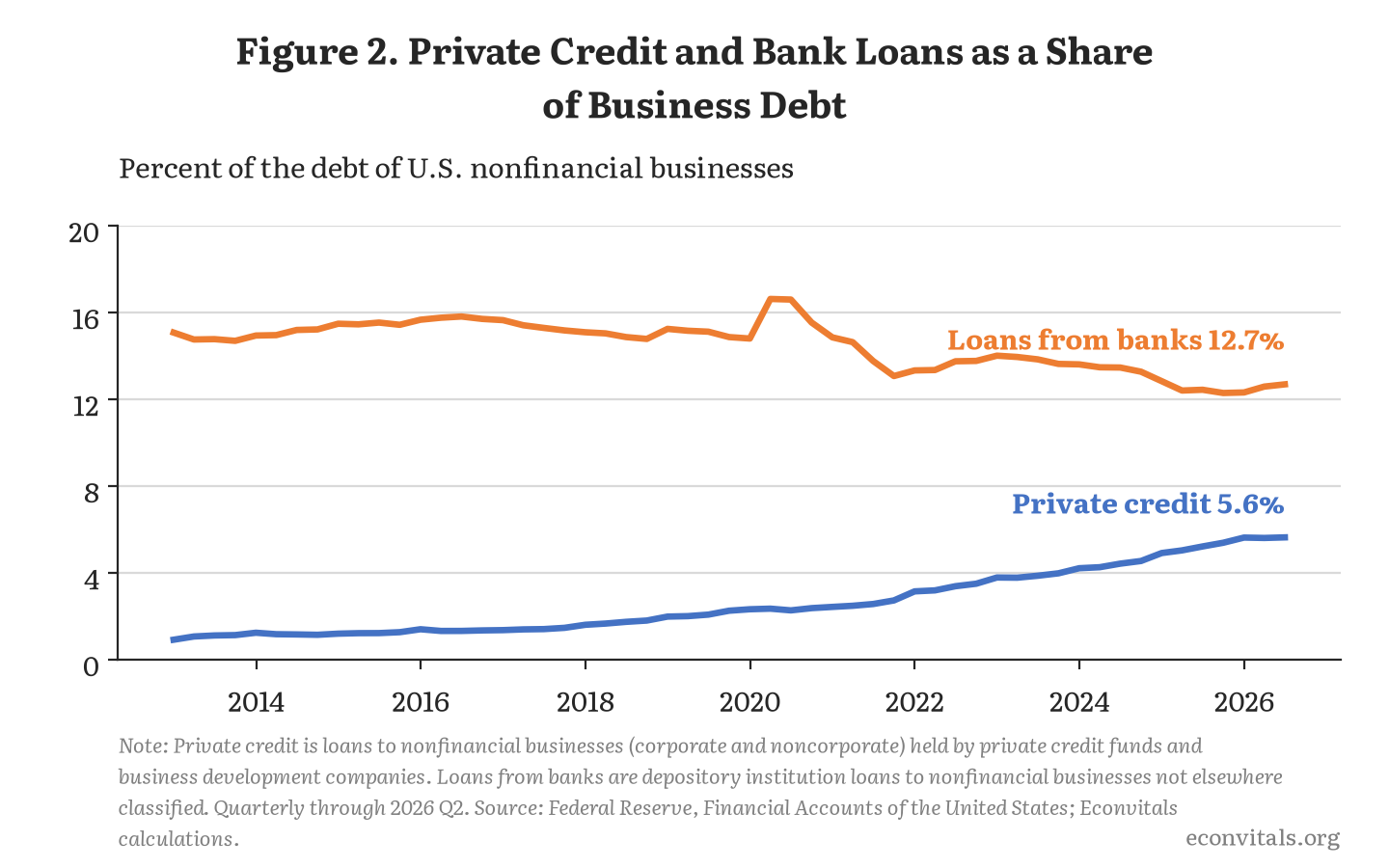
Private credit lending to businesses has grown enormously, from $0.4 trillion, or 2.3 percent of nonfinancial business borrowing, in 2019 to $1.4 trillion, or 5.6 percent, in the second quarter of 2026 (Figure 2). That is still less than half of what businesses borrow from banks—and both are much smaller than the other sources of business borrowing taken together, including corporate bonds and mortgages.
If the companies that private credit lends to do not pay back, then the investors in the private credit funds bear the cost. The firms that manage those funds get hit indirectly through the expectation of lower fees in the future. That is why the stock prices of the major listed managers have fallen so much: since the end of 2024 Blue Owl is down 54 percent, KKR 34 percent, Blackstone 24 percent and Apollo 23 percent, while the S&P 500 is up 27 percent (Figure 3). Much of the decline related to worries about loans to software companies and investors asking to pull money out of the funds sold to individuals. Notably, the shares of the publicly traded business development companies—funds that hold the loans themselves—have fallen much less, about 8 percent, which suggests the losses on the loans themselves so far are modest.
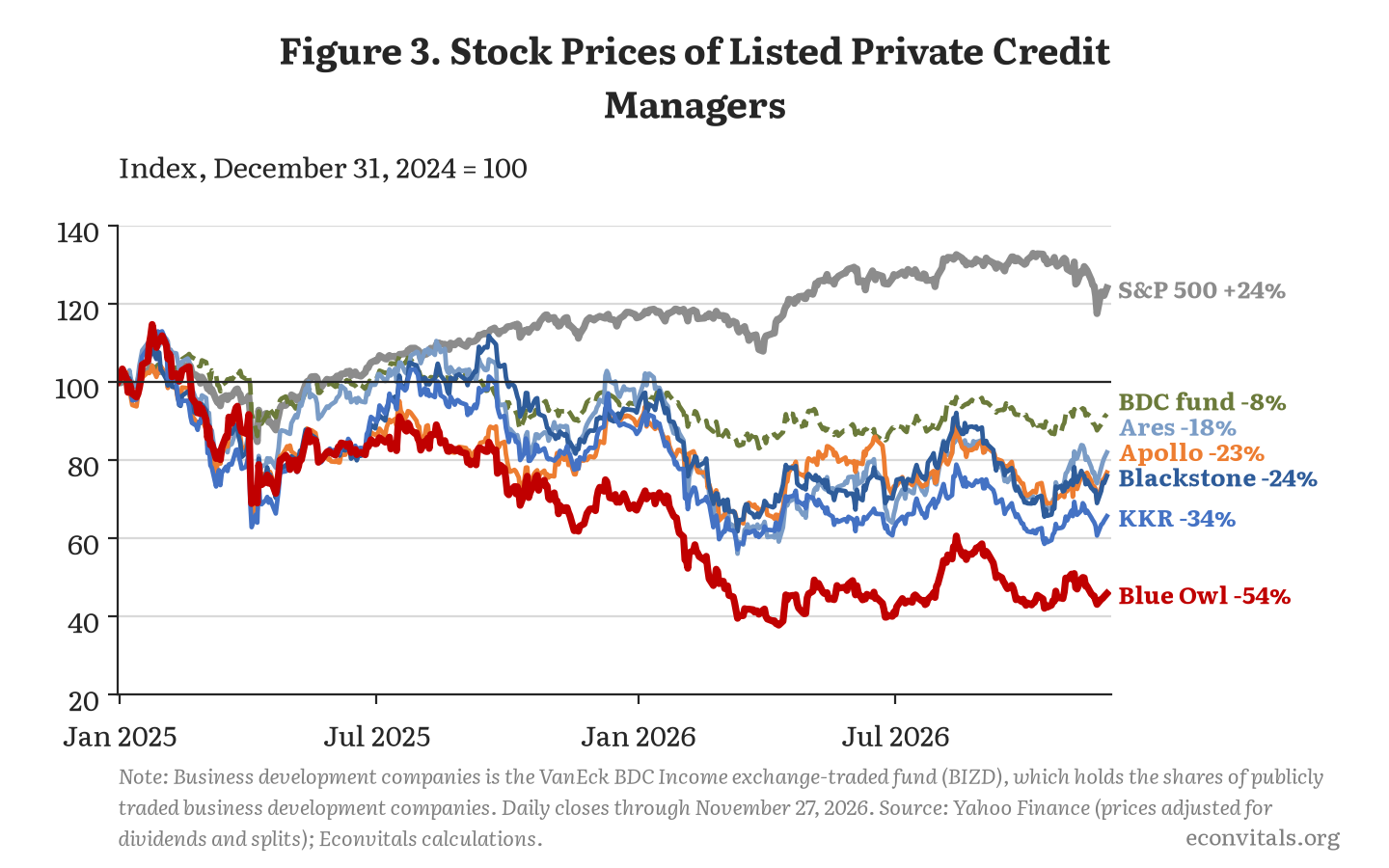
This has been bad for people who invested in these companies at the peak, but does it pose broader financial risks? So far the answer has been no. Private credit is not like banks in that it is not financed by demand deposits which can be withdrawn at any time. The maturities of the borrowing and lending are also relatively matched: most private credit funds lock up their investors’ money for 7 to 10 years. The newer funds sold to individuals that do allow withdrawals have gates limiting them to about 5 percent of the fund a quarter. And the loans held by insurance companies are subject to insurance regulators’ capital rules and are generally the safer, higher-rated pieces, different from what goes into the riskier funds.
The best case for concern was made by Natasha Sarin in April, in a New York Times essay titled “This Is Starting to Look Like a Slow-Motion Bank Run.” She argued that mounting withdrawals could add up to a bank run. I agree with her main policy points (e.g., I do not support the Labor Department’s proposal to make it easier for 401(k) plans to hold private credit, which would lead to more unsophisticated investors who could risk runs on private credit), but the data in the seven months since she published her piece has been more reassuring than not on the slow motion bank run itself. For example, redemption requests at Blue Owl’s largest fund sold to individuals have fallen in each of the last two quarters, from the 22 percent of shares she cited to 19 and then 17 percent, and the fund has limited redemptions to 5 percent. Across the industry the gates have held, and there has been no sign of a fire sale. Of course, that could change going forward.
These are the reasons that the Treasury’s Office of Financial Research concluded that “financial stability vulnerabilities associated with private credit appear low because private lenders are not very leveraged, and most have financing that is locked up for long periods.”
Nevertheless, official bodies are still worried about the unknown unknowns in the sector. The Financial Stability Board warns that private credit “remains untested at its current size, scope, and concentration in a few economic sectors,” but even their worry is mostly about losses, not runs. The Federal Reserve’s latest report found that withdrawal requests at the funds sold to individuals “trended lower through the third quarter of 2026, though they remained elevated.” (One page on the Risk Monitor tracks and updates financial risk assessments from official institutions.)
One risk to keep an eye on: banks are increasingly lending to private credit firms and other parts of the financial system. Some of this is regulatory arbitrage: a loan to a private credit fund carries a lower capital charge than lending directly to the companies the fund lends to. Bank loans to all nonbank financial firms reached $1.6 trillion this month, of which a few hundred billion dollars went to private credit funds. The FDIC judges these loans to have “low direct credit risk,” and the IMF estimates that a 20 percent loss on banks’ exposures to private credit and private equity would cost them about 2 percentage points of capital, well below the 13 percent capital banks have on hand. But this is only one source of bank exposure to the AI economy and how it all adds up and amplifies is worth being nervous about.
I am not saying to do nothing. Regulators should actively monitor. They should not take steps to expand the risk, like widening who can invest in private credit. Insurance regulators should continue to increase capital requirements for risky securities. I would be even more reassured if we had a national insurance regulator instead of leaving it to the states chosen by each insurance company, but that is an issue for another day.
Nvidia is not a bank
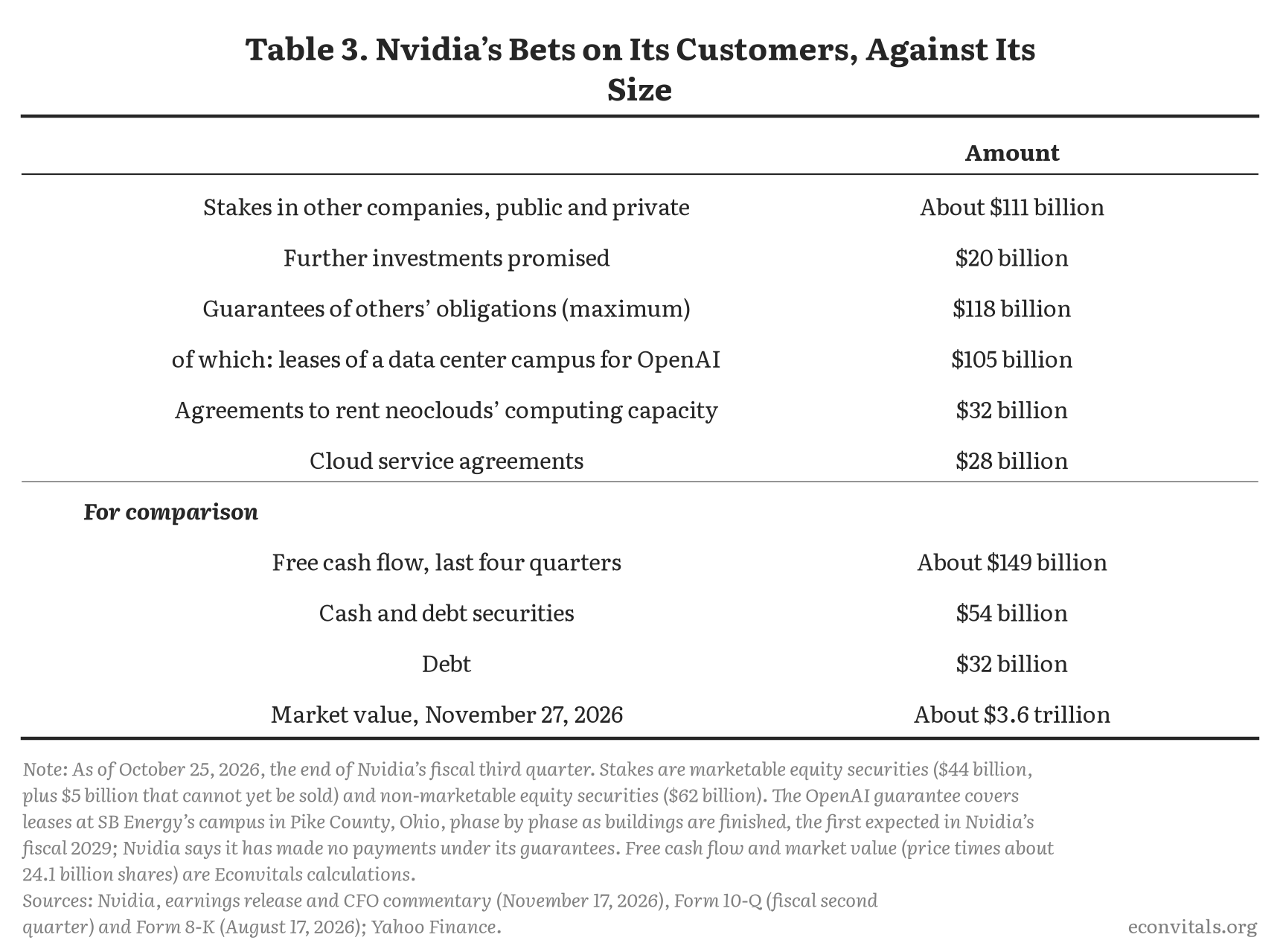
Nvidia is increasingly spoken of as if it is a bank—with the attendant fear that if everything goes south its failure could be like a bank failure. There is good reason for the holders of the $3.6 trillion in Nvidia stock (as of this writing in late November) to be nervous. The company holds stakes worth about $110 billion in other companies, much of it in its own customers—AI labs and the neoclouds that buy its chips to rent them to others. It has guaranteed up to $118 billion of other companies’ obligations. And it has agreed to rent up to $32 billion of computing capacity from neoclouds, in effect a backstop for their business (Table 3).
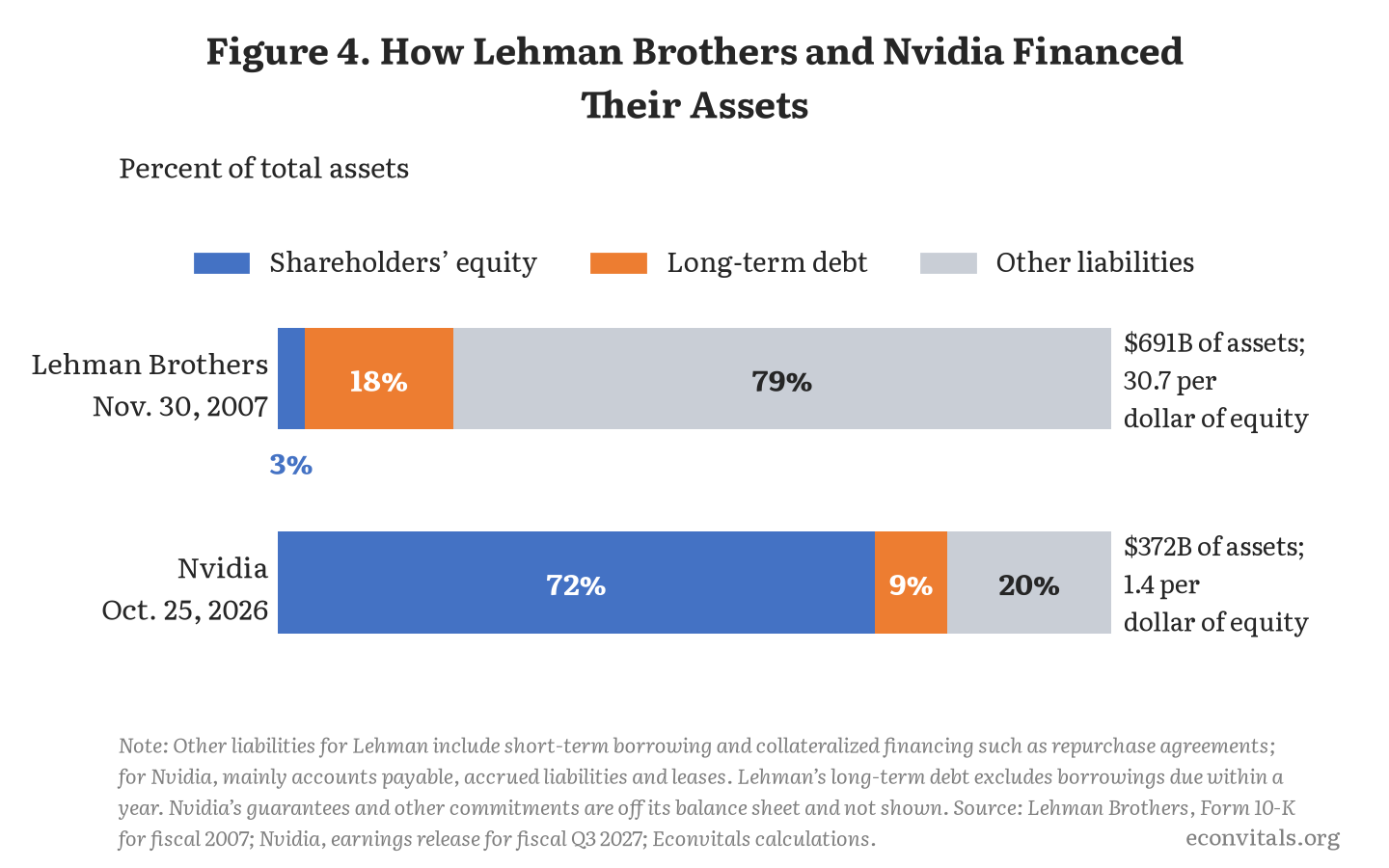
But again, the question is not whether there are risks for Nvidia’s shareholders but whether those risks could propagate throughout the economy. Here there is much less concern. On the eve of the crisis, Lehman Brothers held about $691 billion of assets against $22 billion of equity as of November 30, 2007, a leverage ratio of 31 to 1. When those assets turned sour, it was not just its shareholders who were wiped out; the risk that others would not be paid, including on investments that were considered completely safe, was very high. A run on similar institutions followed, with even larger effects.
Nvidia, in contrast, is making its investments out of its enormous cash flow, not by borrowing: it generated about $150 billion of free cash flow over the last year and has only $32 billion of debt. Its investments, commitments and guarantees together come to less than a tenth of its current market value, although of course that market value could fall in the same circumstances in which its investments and guarantees lose money. Nvidia may be a great company, it may be making reckless bets, but it is not actually a bank in the sense of highly leveraged maturity mismatch supported by a thin layer of capital (Figure 4). If its bets go bad, its shareholders will lose, and that will show up in the wealth effect I estimated in the third post, not in a run.
Similarly, the off-balance-sheet vehicles of technology companies should concern their investors but are not a systemic risk. The Federal Reserve estimates that the technology companies’ take-or-pay contracts, future leases and other similar obligations exceed $3 trillion, but it notes that through these arrangements the largest technology firms “may absorb losses in the event of a future downturn, mitigating their effects on the rest of the financial system.”
Is there an AIG in all of this?
When I discussed these issues recently with Paul Krugman and Jared Bernstein, Paul raised the example of AIG: “AIG was a quintessentially solid business, an insurance company with real cash flow, except it turned out it really wasn’t. What it was was a gigantic, overleveraged shadow bank. Is there anything like that in the current landscape?” What made AIG so dangerous was that even though its initial losses were publicly reported, no one was focused on the contingent risks of the insurance it had sold on hundreds of billions of dollars of mortgage-related securities. Having a weak regulator, the Office of Thrift Supervision, did not help but investors and analysts generally missed the risk as well.
Is there an AIG in the AI boom? I worry because I did not pick out the AIG problem in advance. But at least with hindsight there are two aspects to AIG that do not hold today. First, the banks buying insurance from AIG treated the promises as riskless and held little capital against them. Today the promises are treated as risky. Second, the guarantors are among the most profitable companies in the world, with little debt and enormous equity cushions. That said, more disclosures of the financial arrangements and guarantees behind this buildout would be welcome.
That said, if there is one thing I would keep an eye on, it would be, well, insurance companies again—in particular the possibility that many people holding annuities cash them out at the same time to put their money somewhere else, forcing insurers to sell loans that are hard to sell quickly. That would be a novel type of run. Not high probability, but not impossible either.
What to look for going forward
I could be wrong about the financial system as of late November 2026. Smart and experienced economists, including Federal Reserve Chairman Ben Bernanke, thought that mortgage losses would be relatively contained and could be absorbed by bank capital. In March 2007 Bernanke told Congress that “the impact on the broader economy and financial markets of the problems in the subprime market seems likely to be contained.” The financial system as a whole is affected by psychology and can have multiple equilibria—one where people are confident and everything works out and another where panic becomes self-fulfilling. Not everything is equally subject to this: I have argued that private credit and tech companies are not subject to the same kinds of runs as banks. But you never know.
There is no one statistic to monitor for financial risk. In fact, to the degree that you monitor one, Goodhart’s Law can set in—that one will end up being fine but the risk will migrate to where you are not looking. A few statistics are not much better than one, but they are at least part of the answer. Here are a few I would suggest monitoring, most of them on the Risk Monitor:
- Spreads on the broad corporate bond market as a whole, not just the weakest AI names (Risk Monitor).
- Bank lending to nonbank financial firms and any losses on it (Risk Monitor).
- Withdrawal requests at private credit funds, especially if gates spread from funds sold to individuals to institutional ones (Risk Monitor).
- How much of the hyperscalers’ capital expenditures are financed by borrowing instead of their own cash flow (Risk Monitor).
- Increased short-term funding, like commercial paper or repo, in the data center and broader AI economy.
Finally, if things start to go wrong, that is not the whole story. Policymakers and other parts of the economy will react. That is the subject of what will be the last post in this series.
Note: This post was written by Jason with title, edits and fact checks by Claude. The data work was done interactively with Claude. A replication package is available on Econvitals.
Jason’s Occasional Posts are written by Jason himself; almost everything else on Econvitals is written by Claude. Subscribe to get them by email, or read the others.