| |||

Aging explains almost all of the drop in the employment-population ratio
By Jason Furman
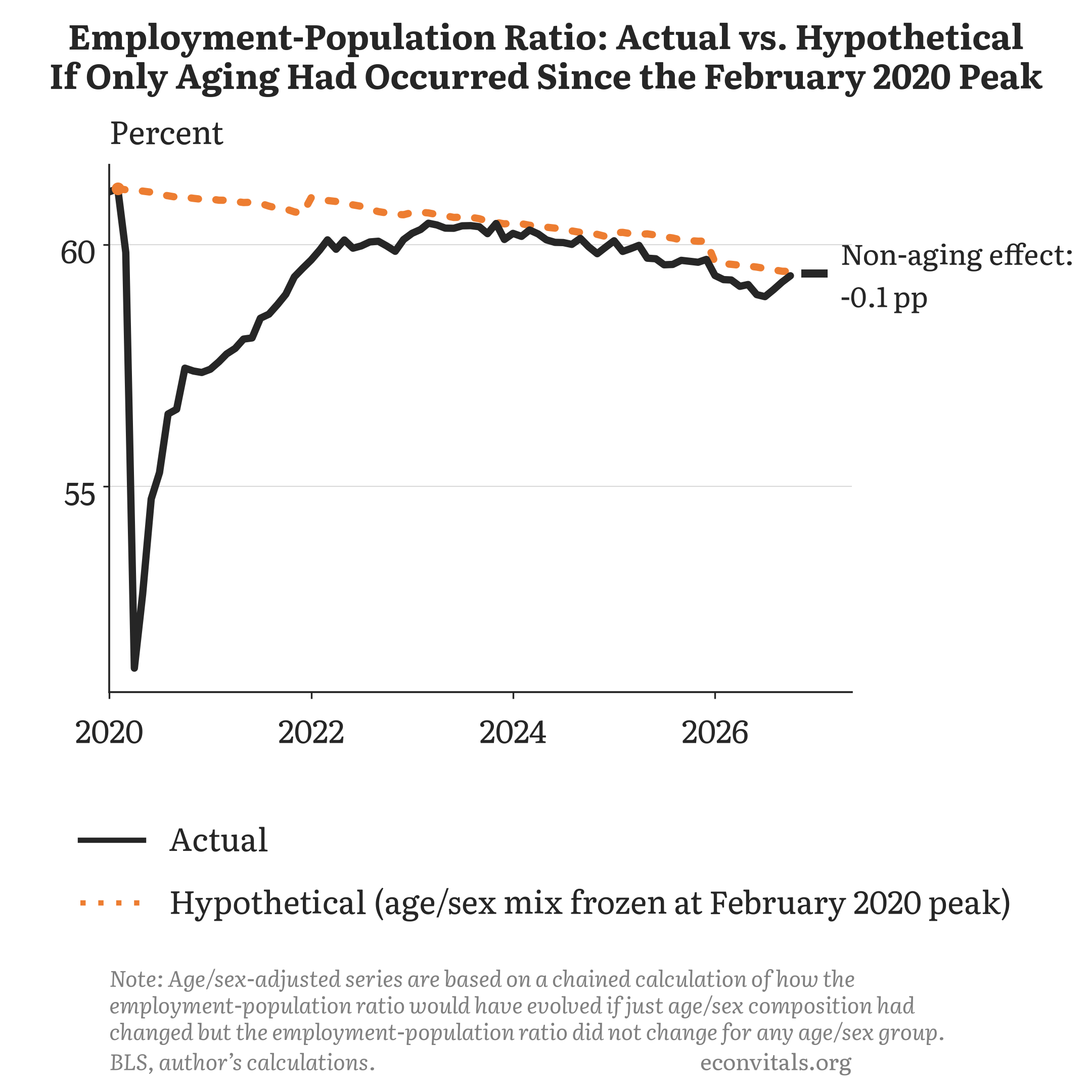
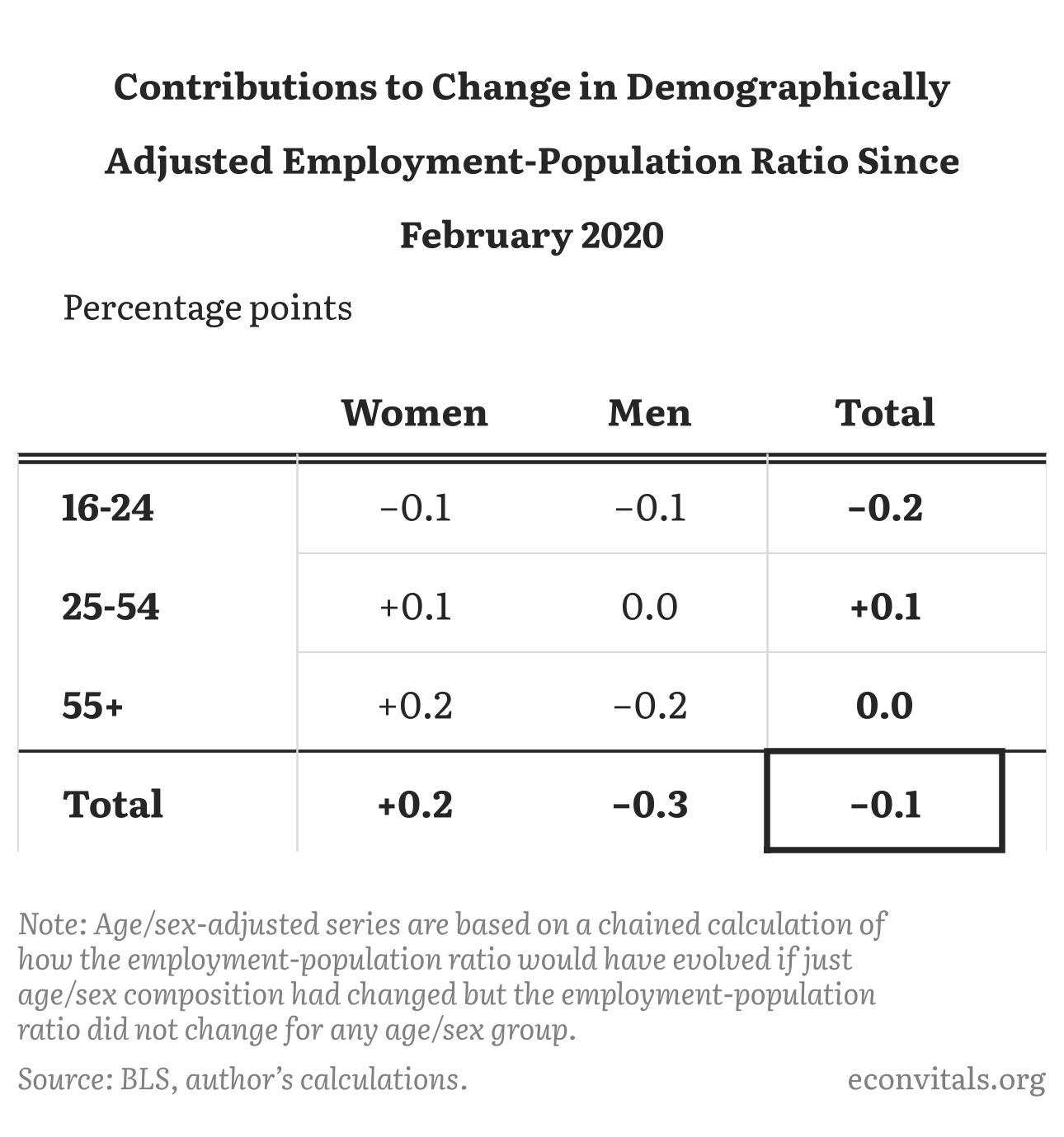
The employment-population ratio has fallen 1.8 percentage points since February 2020. This is almost entirely the result of an aging population: adjusted for demographic changes, it has fallen 0.1 percentage point (which is basically zero between friends). Employment rates for men have fallen, while they’ve risen a little for women. And they have fallen for people ages 16 to 24, while rising a little for the prime-age group. Overall, however, the shifts within each demographic group are relatively mild, and the overall story is one of stability and continuity. Note that all of these demographically adjusted estimates are maintained and regularly updated on Econvitals.
Interesting Research
Selected and written up by Claude
Lottery windfalls go to spending at the bottom and to saving and leisure at the top — Rajashri Chakrabarti and co-authors have a new Philadelphia Fed working paper. It links Canadian lottery winners to their tax and credit records. Low-income winners spent more of the money. High-income winners saved more of it and worked less. That gradient has three policy uses. It bears on how to target stimulus, because a check to a lower-income household does more for demand. It sheds light on what a universal basic income would do to labor supply at different points in the distribution. It also feeds into the optimal top tax rate, since earnings at the top respond to unearned income. Lottery prizes are a clean source of variation. They are also one-time windfalls, so they may not show how people would respond to a permanent transfer.
A Social Security sovereign debt fund would likely fail and add heavily to debt — President Trump has reportedly shown interest in Senator Bill Cassidy’s plan. It would borrow $1.5 trillion to buy equities and let Social Security borrow for 75 years. CRFB applies simulations from Boston College’s Center for Retirement Research to the proposal. In the median case the fund covers less than half of the program’s shortfall if expected returns are high. It covers less than one-tenth if returns are low. Only about 30% of simulations earn enough to repay all the borrowing. The 6.5% real return the plan assumes is probably optimistic. On Trustees’ projections, total borrowing could reach $195 trillion in inflation-adjusted terms. The fund amounts to a leveraged equity bet, and it would not fix the gap between benefits and revenues.
The Day Ahead
PCE (October, 8:30 AM) — consensus headline +0.3% m/m, core +0.3% m/m; headline 3.8% y/y, core 3.2% y/y
GDP (Second Estimate) (Q3, 8:30 AM) — consensus +3.4% q/q annualized
Personal Income & Outlays (October, 8:30 AM) — consensus personal income +0.4% m/m, personal spending +0.4% m/m
Durable Goods Orders (October, 8:30 AM) — consensus headline +0.7% m/m
Initial & Continuing Jobless Claims (8:30 AM) — consensus initial claims 201k, continuing claims 1,710k
New Home Sales (October, 10:00 AM) — consensus 650k saar