Veterans who served after September 11, 2001, spent most of the last two decades catching up in the job market, and by 2019 they had largely caught up. Over the past year they have fallen behind again. In the year through September (there was no survey in October 2025), their unemployment rate averaged 4.5 percent, against 3.6 percent for nonveterans who look like them in age, sex and education. A year earlier the two groups were about even.
The main reason runs through the federal government, which employs about one in seven of these veterans and spent the past year shrinking and sharply cutting its hiring.
Comparing like with like
There are about 4.4 million post-9/11 veterans in the labor force. They are not a cross-section of America: most are men, most are in their thirties and forties, and almost all have at least a high school diploma or the equivalent, which the military requires of nearly all recruits. Comparing them with all nonveterans mixes up the effect of being a veteran with the effect of being a middle-aged man with a diploma.
So the chart below compares them with a matched group: nonveterans weighted so that they have the same mix of ages, sexes and education levels as the veterans. The numbers come from the Census Bureau’s monthly household survey, the same survey behind the official unemployment rate.
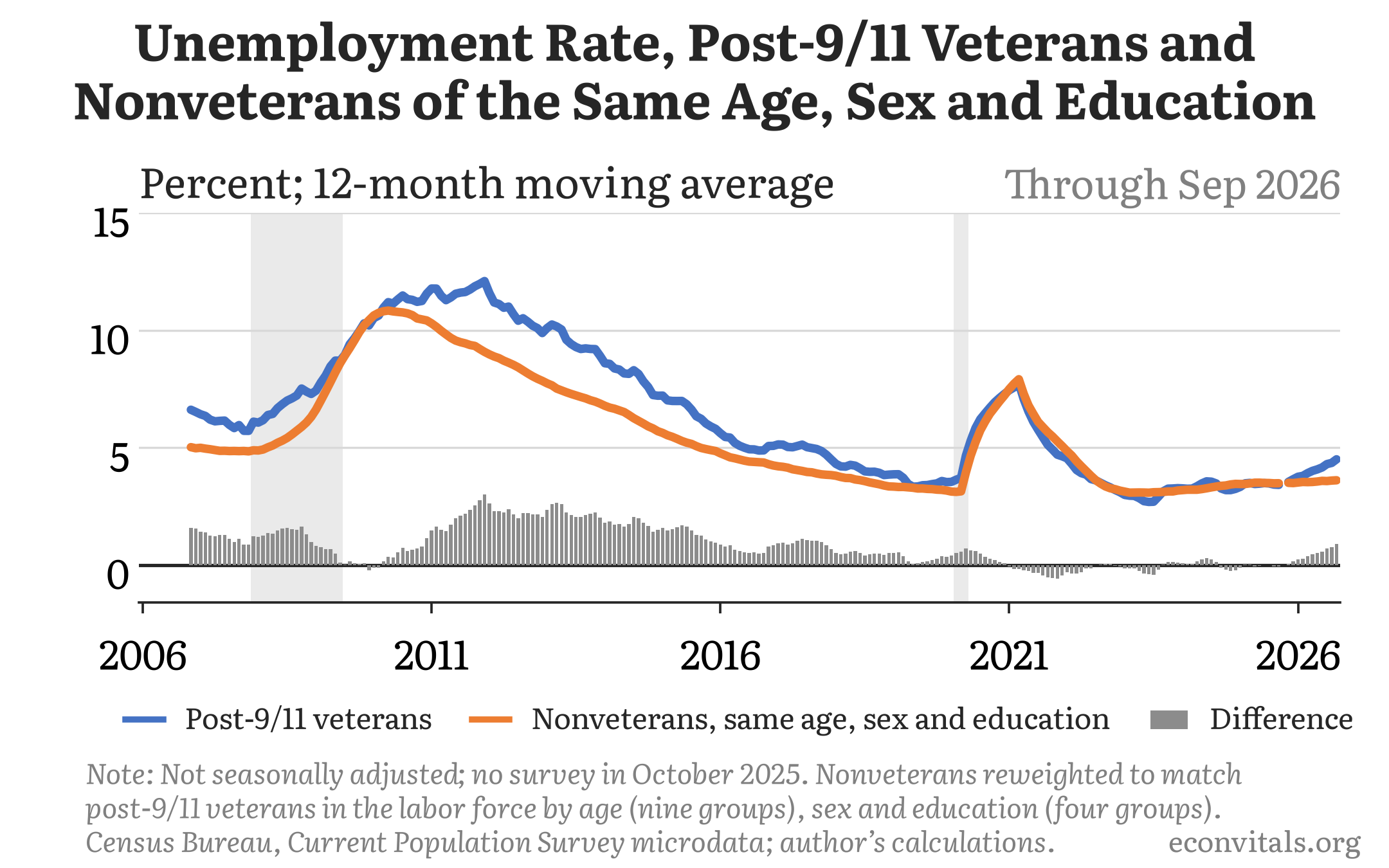
A long climb back
In the early 2010s, post-9/11 veterans had much higher unemployment than comparable civilians. At the end of 2011 the gap was about 3 percentage points.
Researchers have pointed to two explanations. Economists at the Chicago Fed found that recent veterans had unemployment rates similar to civilians’ from 1994 to 2004, that the gap opened in 2005, and that prolonged overseas deployments accounted for most of it. A RAND study found that veterans’ extra unemployment faded quickly with time out of the service, which points to the job search that follows leaving the military rather than any lasting handicap.
Then the wars wound down. The Army shrank from about 570,000 soldiers in 2010 toward a target of 490,000 by 2015, and departures from active duty to civilian life reached about 169,000 in fiscal 2012, the most in the five years (2011 to 2015) examined by the Government Accountability Office. In 2011 Congress also made the military’s transition assistance program mandatory for most departing service members through the VOW to Hire Heroes Act.
As fewer people left the service each year and the post-9/11 generation got older and more settled, the gap closed. By 2019 it was down to about a third of a point, and from 2021 through 2025 post-9/11 veterans’ unemployment was about the same as comparable civilians’. Unemployment insurance records tell the same story: first payments to newly discharged service members fell from about 90,500 in fiscal 2012 to about 12,200 in fiscal 2025, according to Labor Department data.
What changed in the past year
Comparable civilians’ unemployment barely moved over the past year, rising about a tenth of a point. Post-9/11 veterans’ rose more than a full point. So this is not the overall job market.
The difference is the federal government. About 15 percent of employed post-9/11 veterans work for it, against about 2 percent of comparable nonveterans. The Bureau of Labor Statistics’ annual report on veterans finds the same pattern: 16.2 percent versus 2.1 percent in 2025. Veterans get preference in federal hiring, and their skills carry over naturally to the Defense Department and Veterans Affairs.
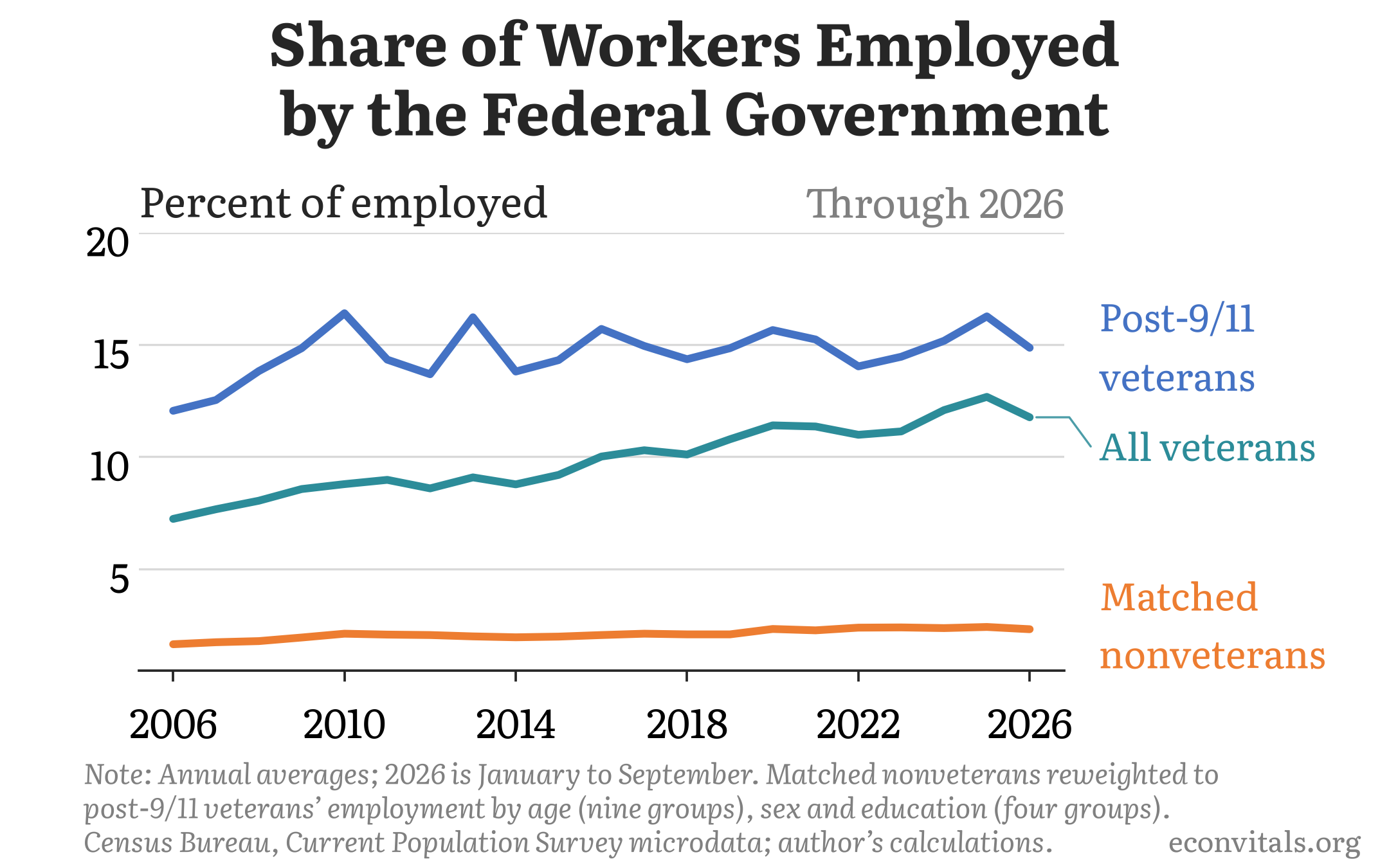
That made veterans unusually exposed when Washington cut back. The GAO counts about 256,000 fewer employees, an 11 percent drop, at 22 large agencies between December 2024 and January 2026; about 129,000 of the people who left took the “deferred resignation” offer. Federal hiring fell by more than half, from about 263,000 new hires in 2024 to about 117,000 in 2025, according to the Pew Research Center, and an October 2025 executive order kept new hiring under tight review by agency hiring committees.
About four-fifths of the past year’s rise in post-9/11 veterans’ unemployment is among those whose last job was with the federal government, either as civilians or in uniform. Most federal jobs are outside the Washington area, at military bases and VA facilities, and so is most of the rise: in DC, Maryland and Virginia, veterans’ unemployment did not go up.
The largest single piece of the rise is people whose last job was in the military itself, mostly in their twenties and thirties. Federal jobs have long been a common landing spot for people leaving the service, and a hiring freeze narrows that path. This part of the picture is less certain than the rest. Claims for unemployment insurance from newly discharged service members were flat this year, and the jump in the survey began in November 2025, when the household survey had a record-low response rate after the government shutdown. Some of it may reflect people leaving the military under circumstances that do not qualify for those benefits, and some may be survey noise.
What comes next
There are some signs the worst has passed. Post-9/11 veterans’ unemployment rate was 3.4 percent in October, below the 3.8 percent for all nonveterans, according to BLS figures that are not adjusted for age or education. The big 2025 wave of deferred resignations has passed.
The hiring restrictions have not. For two decades the federal government has been one of the most reliable bridges from military to civilian work. If that bridge stays narrow, the job market will be harder on people leaving the service, whatever happens to the economy as a whole.